

Didn’t understand Michel Foucault? Let’s ask AI!
On education, artificial intelligence, and a remarkable website
Sometimes a chance visit to a website is enough to raise questions that reach far beyond that website.
Google Chrome recently took me to lernhelfer.de, specifically to an article about the French philosopher Michel Foucault in its reference section for school students.
Lernhelfer is a service from Duden and Learnattack. It is a platform intended to make knowledge available to students and help them learn.
A good idea. An important one, in fact.
Particularly in Germany, where educational success still depends considerably on individual circumstances and the support available, such services are welcome in principle.
The website initially makes an excellent impression. Professional design, clear navigation, pleasant typography, a well-organised structure. You immediately know your way around.
And then you start reading.
Knowledge that presupposes understanding
The article begins with a brief biographical introduction before describing Foucault’s philosophical thinking:
“In his thinking, he combined elements of structuralism […] with hermeneutic approaches.”
Shortly afterwards, it refers to historical forms of discourse and the formation of the modern subject.
That is not wrong simply because it is hard to understand. Foucault’s thinking certainly cannot be reduced to a few simple sentences without difficulty.
But who is this text for?
For students studying literary and intellectual history as part of their German Abitur.
To understand the opening, they would already need to know what structuralism, hermeneutics, discourse, and the modern subject are.
The article uses concepts it ought to be helping readers understand.
Of course a demanding text is allowed to be demanding. This is not about shielding students from complex concepts. Quite the opposite.
But there is a difference between using a technical term and teaching it.
Presenting knowledge is not the same as enabling understanding.
A student might be able to memorise this text and reproduce its terminology in an exam without developing any idea of their own about what Foucault actually investigated.
And with Foucault, of all people, that is a remarkable irony.
His central research interests included the emergence of orders of knowledge, the social significance of concepts and classifications, and the relationship between knowledge and power.
Among other things, he investigated the conditions under which particular statements can count as true, scientific, or legitimate.
Here his philosophy itself confronts us as institutionally presented knowledge.
Didn’t understand Michel Foucault?
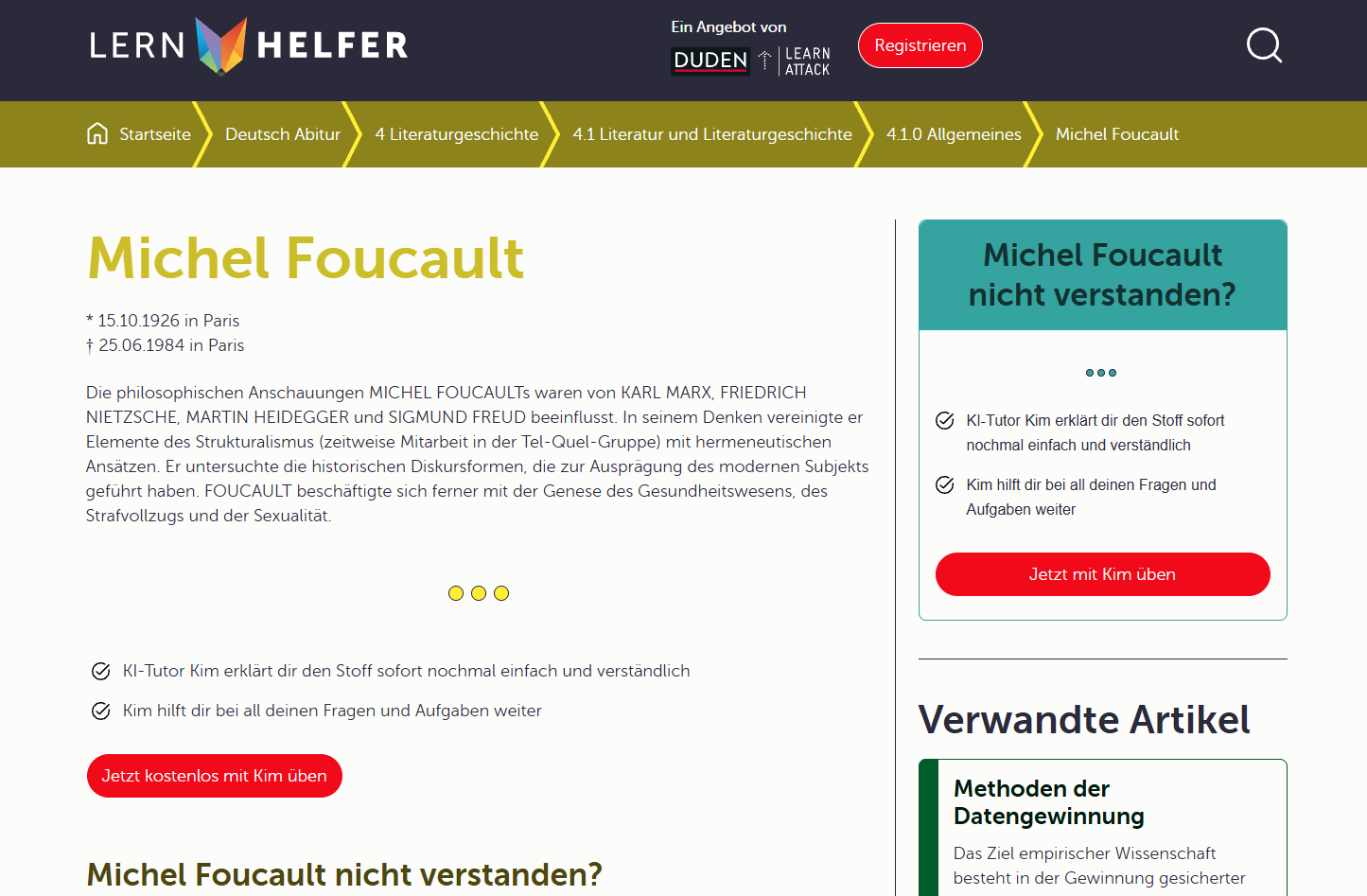
Figure 1: Screenshot of the Lernhelfer article with the introductory text and the AI tutor offer. Taken on 12 November 2026.
Alongside the article, a conspicuous offer appears:
“Didn’t understand Michel Foucault?”
An AI tutor called Kim promises to explain the material again immediately, simply and clearly.
How convenient!
First, an educational platform presents a text that requires considerable prior knowledge. Then it offers technical assistance with understanding it.
You can see that as a useful addition.
But you can also ask an uncomfortable question:
Why doesn’t the platform first improve the explanation it already provides?
Perhaps Kim really is excellent at explaining things. Perhaps the AI tutor helps students think independently and develop questions of their own.
I have not investigated that. My criticism is initially directed at the observable design of the service, rather than at Kim’s quality.
That design already conveys a message.
The student is confronted with a demanding text. If they do not understand it, help is immediately on offer.
The possibility that the explanation itself is inadequate goes unmentioned.
Instead, attention centres on the student’s failure to understand.
And now there is a technical solution for that.
Having problems at school?
While I was looking at the article, a popup appeared repeatedly, covering the page’s actual content and dimming the background.
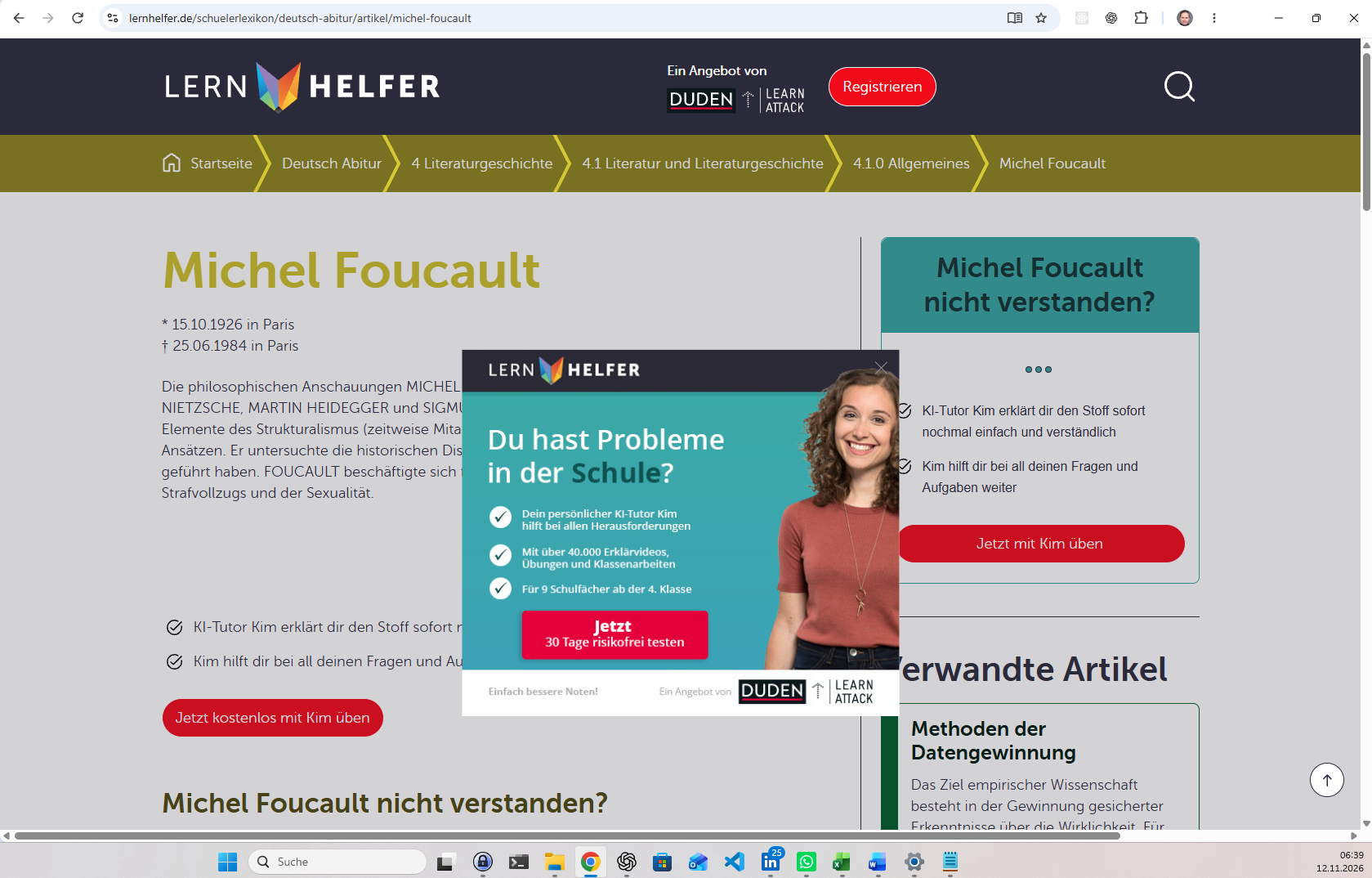
Figure 2: Screenshot of the Lernhelfer popup over the dimmed Foucault article. Taken on 12 November 2026.
A young woman looks at me with a friendly smile.
Beside her are the words:
“Having problems at school?”
These are followed by promises of personal AI support, references to extensive learning materials, and a prominent red button:
“Try it risk-free for 30 days”
The little cross that lets me close the advertisement is much less noticeable.
I am not having problems at school. I am not a school student either.
But that is not the point.
The design is clearly aimed at people who might be facing difficulties at school.
And it addresses them through a possible insecurity.
This is advertising. Advertising may address needs and offer solutions.
But we should look more closely when the people being addressed are children and teenagers, and the advertised product is supposed to support their capacity to learn.
Because this is about more than selling a service.
It is also about young people’s relationship with their own abilities.
What does a child learn about themselves when a learning environment repeatedly suggests that they have a problem requiring additional help?
That question does not go away just because the help on offer may work well.
When design becomes a problem
On 11 November 2026, the European Commission presented its proposal for a so-called Digital Fairness Act.
Among other things, it addresses manipulative online design practices, often called dark patterns.
A familiar example is an online shop suggesting artificial scarcity: Only a few left! Buy now!
The intention is to move people towards decisions they might not have made without that pressure.
The EU is also explicitly addressing other forms of manipulative design and the particular need to protect minors.
Does that make the Lernhelfer page unlawful?
I am not claiming that.
Whether this particular design could legally be classified as an unlawful dark pattern would require a separate assessment.
But the structural resemblance deserves attention.
In the familiar online shopping example, attention is drawn to scarcity that may not even exist.
On Lernhelfer, a possible difficulty in understanding is invoked and an immediately available commercial solution is presented.
In one case, the message is: You need to buy now, or you will miss out.
In the other: You need help to meet the demands placed on you.
These are different situations. They should not automatically be equated, either legally or in terms of their effects.
But both raise the same fundamental question:
Does the design primarily help users make up their own minds — or is it intended to steer their behaviour in a particular direction?
We should take that question especially seriously in places where children are supposed to learn.
Professional does not necessarily mean understandable
What particularly concerns me about Lernhelfer is the discrepancy between the platform’s professional design and the educational quality of the text I examined.
The website looks clear.
The text is much less clear for its presumed audience.
That is not a minor distinction.
We tend to infer the quality of what is presented from the quality of its presentation.
A professionally designed website conveys credibility. A familiar brand conveys trust. A text written in scholarly language conveys intellectual authority.
All of that may be justified.
But it does not replace an independent assessment of the content.
One very simple detail illustrates the problem: the top of the Foucault article gives Paris as his birthplace. Further down, the same article correctly names Poitiers.
This is not a complicated philosophical dispute. It is a verifiable contradiction within a single publication.
And a professionally designed educational platform, intended to help students find their bearings, leaves that contradiction in place.
The individual mistake would hardly merit an essay.
It becomes interesting as part of the larger picture.
A presentation can create an impression of clarity without having been sufficiently thought through itself.
That applies far beyond educational platforms.
In politics, too, we regularly encounter the idea that certain decisions simply need to be communicated better.
Sometimes that is undoubtedly true.
But it makes a considerable difference whether a sound decision has been poorly explained, whether those responsible have not yet adequately understood what they are doing, or whether the people affected understand the decision perfectly well and reject it for good reasons.
Not every problem is a communication problem.
And not every difficulty in understanding can be resolved by an even more persuasive explanation.
What if AI really is the better option?
Someone might object: Perhaps Kim is precisely the solution!
Perhaps an AI tutor can respond to individual questions much better than a static reference article.
I actually find that entirely plausible.
AI opens up possibilities that have scarcely existed in this form before.
A learner can ask follow-up questions, disagree, request examples, examine concepts, test their own ideas, and develop them together with an AI.
The potential is enormous.
But that potential does not realise itself simply because an AI system is available.
A system that merely delivers the expected answer as quickly as possible can perfect rote learning without substantially improving understanding.
A system that tries to remove uncertainty immediately can suppress precisely the uncertainty from which interesting questions emerge.
And a system optimised primarily for user satisfaction can help people confirm their existing convictions very persuasively indeed.
The distinction is therefore not simply between learning with and without AI.
What matters is the kind of collaboration we make possible.
Should AI take the task of answering off our hands?
Or should it expand our ability to ask better questions, notice distinctions, tolerate contradictions, and develop judgements of our own?
Both are technically possible, at least to some extent.
That also makes this a question of design, educational responsibility, and economic incentives.
A critique that would not have taken this form without AI
At this point, I owe my readers a disclosure.
This text emerged from intensive collaboration with ChatGPT.
I showed the AI the Lernhelfer page, described my observations, questioned its responses, and corrected its interpretations.
We talked about Foucault, professional design, political communication, manipulation, motivation, and the limits of our respective understanding.
It was by no means clear from the start that this would become a published article.
The AI did not know my goal.
And, to be precise, I did not always fully know where this exploration was taking me either.
That was part of its value.
There was no predetermined curriculum, no expected model answer, and no clear idea of when the conversation could be considered successfully completed.
There were observations, questions, mistakes, corrections, and new connections.
The AI certainly did not always provide what I found helpful. It sometimes interpreted my statements too hastily, developed plausible explanations that missed my concern, and occasionally wrote so persuasively that the uncertainty behind the explanation was almost easy to overlook.
But those very experiences became part of what we were examining.
That creates a remarkable situation:
This text criticises a naive use of AI as a learning tool — and would probably not have taken this form without AI.
I do not see that as a contradiction.
Instead, it suggests that we should take a more differentiated view of the relationship between people and AI.
Not every collaboration needs a fully specified goal from the outset.
Not every helpful answer is already a correct answer.
Not every uncertainty needs to be eliminated immediately.
And not every interesting question needs a definitive answer.
What I would like to see from Lernhelfer
I do not want to abolish Lernhelfer. Nor do I want to ban an AI tutor.
Quite the opposite.
I would like such services to improve — and for us to discuss more carefully how we can tell whether they are improving.
An educational platform should not be judged solely by how many explanations it offers, how quickly its AI responds, or how many students achieve better grades.
It should also ask:
Are learners becoming more independent?
Are they developing questions of their own?
Do they notice contradictions?
Are they learning to deal with uncertainty?
Can they examine a seemingly authoritative explanation and reject it with good reasons?
And can they eventually do without additional help because they have learned to find their own bearings?
These are demanding criteria. They are harder to market than a promise of better grades.
But for me, they are central to education.
Of course, a privately run educational platform also needs to be economically viable.
There is nothing wrong with that.
Problems arise where commercial success and educational success might diverge — and we stop paying sufficient attention to the distinction.
I would therefore welcome it if those responsible for Lernhelfer saw this critique as an invitation to examine their own assumptions, rather than as an attack.
Perhaps there are good reasons for the chosen design. Perhaps research shows that the AI tutor does foster independent learning. Perhaps there are internal quality criteria that are not visible from outside.
Then it would be interesting to hear about them.
To my mind, however, a convincing response would involve more than explaining the existing services even better.
It would also need to show under what circumstances Lernhelfer would be willing to change them.
And Foucault?
In the end, I return to the philosopher with whom all this began.
Michel Foucault examined how knowledge, social institutions, norms, and power are connected.
He investigated how ideas emerge about what counts as normal, rational, scientific, or deviant.
His thinking is neither simple nor uncontested.
But that is precisely why it is worth getting to know.
Not as a collection of demanding concepts to be mastered for an exam.
But as an invitation to question the apparent obviousness of our own assumptions.
Perhaps that would even be the finest achievement of a learning resource about Michel Foucault:
If, after reading it, a student asked not only what Foucault meant, but also why this knowledge was being presented to them in this particular way.
And if they could then decide for themselves whether to ask Kim for help.
Or simply not to.
How this text was made: This essay was developed in an extended dialogue with ChatGPT and written with AI assistance. The position expressed and responsibility for publication rest with the author.
Sources and notes
- Lernhelfer: Michel Foucault — the article examined, accessed on 12 November 2026.
- European Commission: Digital Fairness Act — legislative proposal of 11 November 2026.
- Digital Services Act, Article 25 — existing provisions on the design of online interfaces. No claim is made here about their specific applicability to Lernhelfer.
The screenshots document the display observed by the author on 12 November 2026. They are used to examine the service depicted.
Comments
Write a comment